

Our guide to landlord taxes can help you prepare for tax day and maximize your rental income tax savings.
The Ultimate Landlord Tax Guide: Tips and Strategies to Stay Ahead of Tax Season
Disclaimer: This guide is intended for informational purposes only. For specific tax advice, it’s always recommended that you speak with a CPA or other tax professional.
Tax season can feel overwhelming for landlords, especially when you're juggling rental income, deductions, depreciation schedules, and ever-changing tax laws. Whether you're a first-time property owner trying to understand what counts as rental income or a seasoned investor exploring advanced strategies like cost segregation, getting your landlord tax obligations right protects your bottom line and keeps you compliant with the IRS.
This comprehensive guide walks through everything you need to know about landlord tax responsibilities: from understanding what rental income you must report to maximizing deductions, implementing strategic tax planning, and avoiding common mistakes that trigger audits or leave money on the table. By the end, you'll have a clear roadmap for navigating tax season with confidence and keeping more of your rental income where it belongs—in your pocket.
Understanding Rental Income and Tax Obligations
Every landlord must report rental income to the IRS, but understanding exactly what counts as income and how it's taxed forms the foundation of smart tax planning. Rental income isn't limited to monthly rent checks. It includes any payment or value you receive in exchange for the use of your property, and the IRS expects you to report it all.
The tax treatment of rental income differs from other types of earnings. Most landlords report rental income on Schedule E (Form 1040), where it's taxed as ordinary income at your marginal tax rate, which ranges from 10% to 37% for 2025, depending on your total income. This means rental income stacks on top of your other earnings, potentially pushing you into a higher tax bracket if you're not careful about timing and deductions.
Understanding the passive income classification is equally important. The IRS generally treats rental activity as passive income, which limits your ability to offset other income with rental losses unless you meet specific criteria. This distinction affects everything from how you claim deductions to whether you can use losses to reduce your overall tax bill.
What Counts as Rental Income?
Rental income extends well beyond the monthly rent your tenants pay. The IRS requires you to report several types of payments and benefits, including:
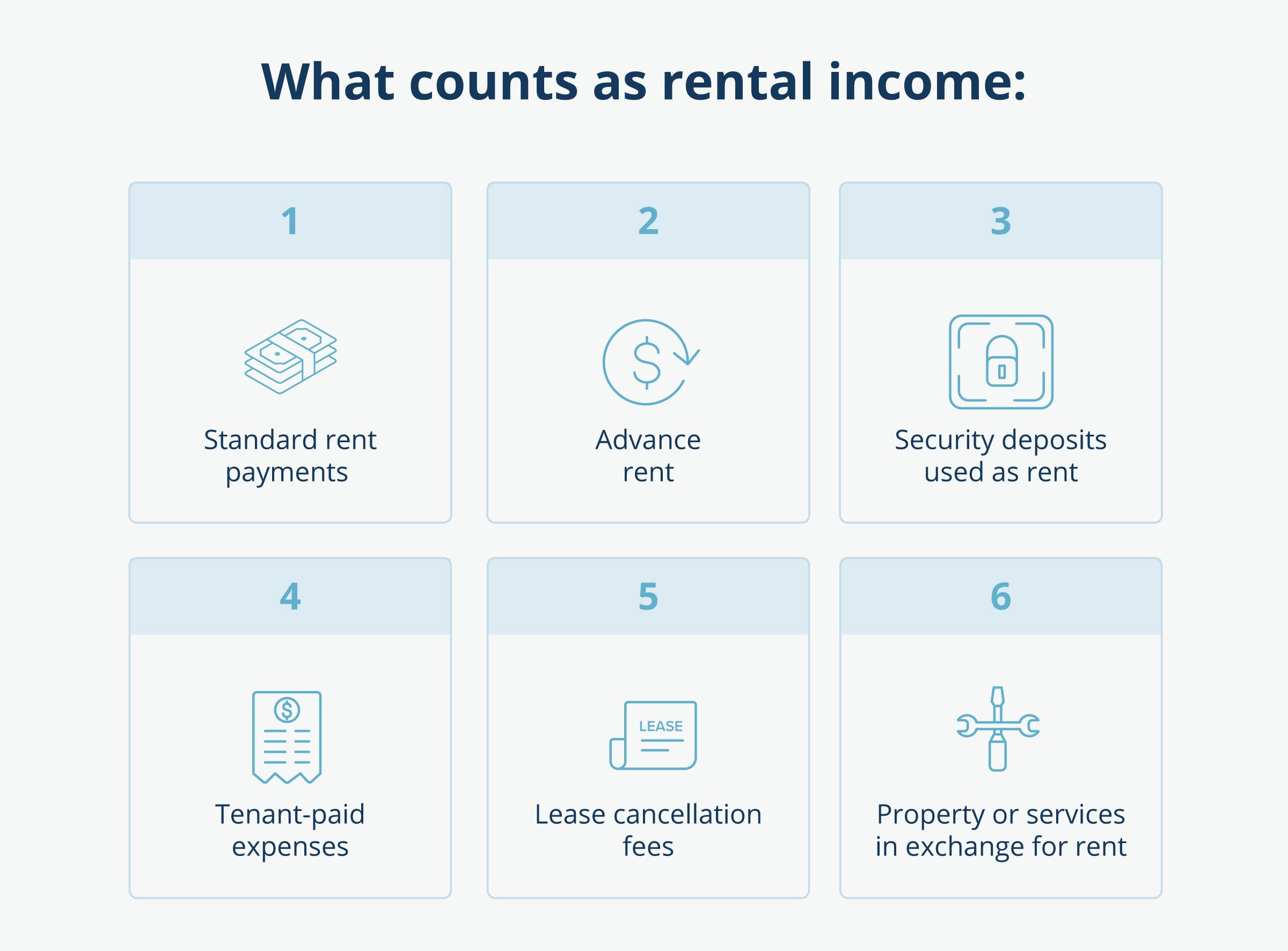
- Standard rent payments – Any rent you collect from your tenants must be reported as income in the year you receive it, even if it covers future months.
- Advance rent – Payments for future rent periods must be reported in the year you receive them, not when they’re due.
- Security deposits used as rent – If you keep a deposit because a tenant broke the lease or used it toward unpaid rent, the IRS treats it as income.
- Tenant-paid expenses – If a tenant pays for something you’re normally responsible for—like utilities or repairs—that amount counts as income.
- Lease cancellation fees – If a tenant pays to break their lease early, that’s also taxable.
- Property or services in exchange for rent – If your tenant offers labor (e.g., maintenance work) instead of cash, the fair market value of that work is considered rental income.
Essential Tax Deductions Every Landlord Should Know
Maximizing deductions is where landlords can significantly reduce their taxable rental income and keep more cash flow from their properties. The IRS allows you to deduct ordinary and necessary expenses related to managing, maintaining, and operating your rental property. The key is understanding which expenses qualify, how to document them properly, and when to claim them.
Many landlords miss valuable deductions simply because they don't know what's available or fail to keep adequate records. Others make the opposite mistake, claiming expenses that don't qualify and risking IRS penalties. This section breaks down the most valuable deductions with clear guidance on eligibility and documentation requirements.
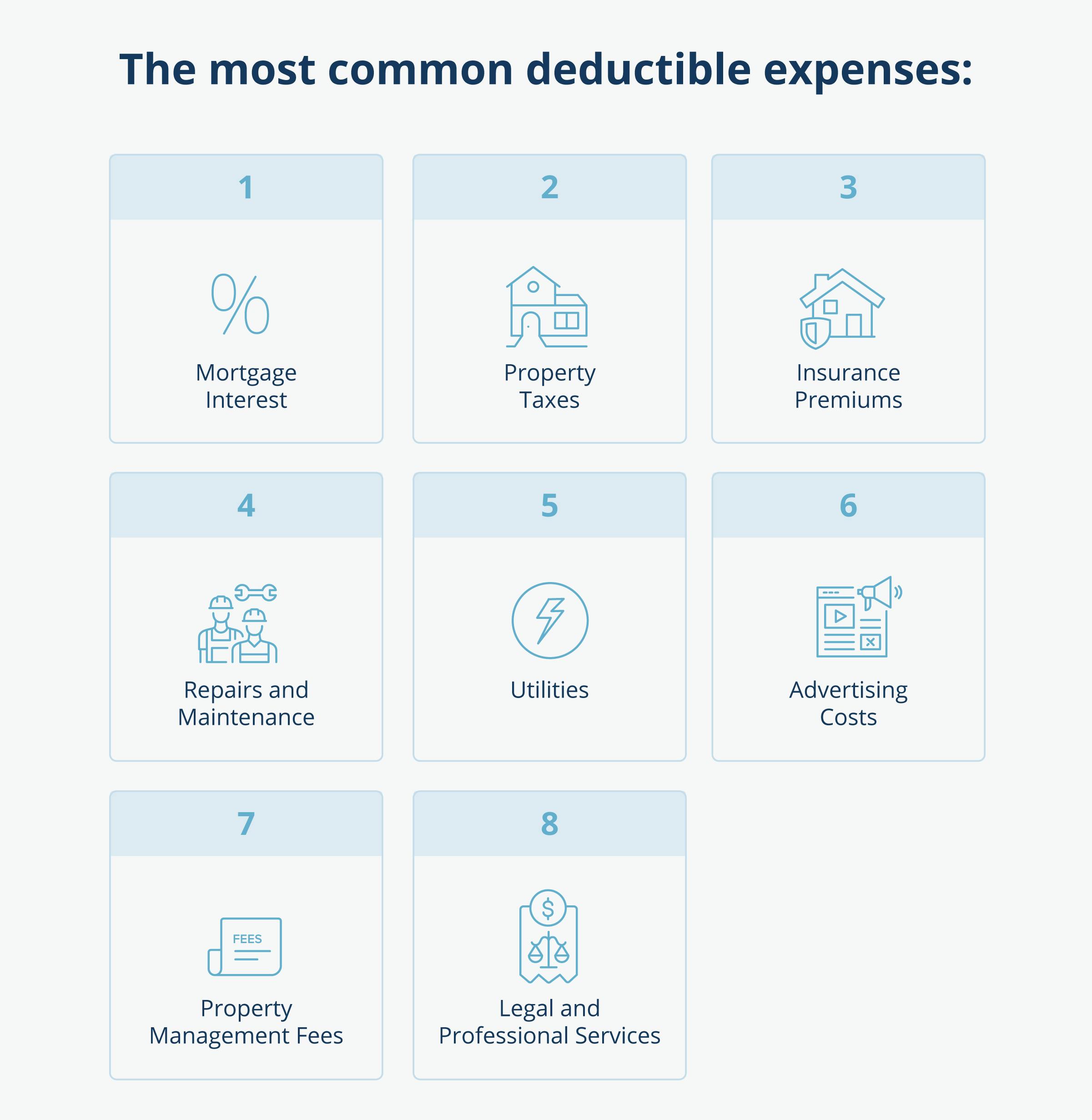
Here are some of the most common deductible expenses:
For a detailed breakdown of specific deductions, our guide to rental property tax deductions offers additional examples and planning tips.
Mortgage Interest
If you have a loan on your rental property, the interest portion of your mortgage payments is deductible. This is often one of the largest write-offs for landlords.
Property Taxes
Annual property tax payments on your rental property are fully deductible.
Insurance Premiums
Premiums for landlord insurance, liability coverage, and other rental-related policies can all be deducted.
Repairs and Maintenance
Costs for ordinary repairs that keep the property in working condition—like fixing a leaky faucet or replacing a broken appliance—are deductible in the year they’re paid.
Utilities
If you cover any utilities for your tenants (electricity, water, trash removal, etc.), those costs count as deductible operating expenses.
Advertising Costs
Any money spent marketing your rental—whether online, in print, or through signage—can be deducted.
Property Management Fees
If you hire a property manager or management company, the fees you pay them are fully deductible as a business expense.
Legal and Professional Services
Accounting, legal, and other professional services related to your rental activity are also deductible.
Keeping detailed records of all these expenses throughout the year will make filing your taxes easier—and help you capture every deduction you qualify for.
Depreciation: The Landlord's Secret Weapon
Depreciation stands out as one of the most powerful landlord tax benefits because it allows you to deduct the cost of your rental property without spending any additional money. This non-cash deduction recognizes that buildings wear out over time, and the IRS lets you recover that cost gradually through annual deductions.
For residential rental property, the IRS assigns a useful life of 27.5 years. This means you can deduct 1/27.5 (approximately 3.636%) of your building's value each year. The catch is that only the building itself can be depreciated—land doesn't wear out, so its value must be excluded from your depreciation calculation.
Capital Gains and Depreciation Recapture
Selling a rental property triggers tax consequences that many landlords overlook during the excitement of closing a deal. Understanding capital gains tax and depreciation recapture before you sell helps you plan strategically, time the sale to minimize taxes, and avoid unpleasant surprises when tax season arrives.
Depreciation Recapture: What You Need to Know
Depreciation recapture is the tax consequence that surprises many landlords at sale time. Every dollar of depreciation you claimed over the years must be "recaptured" and taxed at a maximum rate of 25% when you sell the property. This applies even if you didn't actually claim the depreciation—the IRS assumes you took it and calculates recapture accordingly.
Planning ahead for depreciation recapture helps you avoid cash flow problems at closing. Some landlords set aside a portion of their annual depreciation tax savings to cover future recapture, while others use 1031 exchanges to defer both capital gains and recapture indefinitely.
Record-Keeping and Tax Preparation Best Practices
The foundation of every successful landlord tax strategy is meticulous record-keeping. The IRS requires documentation to substantiate every deduction you claim, and poor records are the fastest way to lose deductions during an audit or miss valuable tax breaks because you can't prove you paid an expense. The IRS doesn't specify exactly how you must keep records, but it does require that you maintain documentation sufficient to prove your income and expenses. For landlords, this means keeping several categories of records:
Income records should include lease agreements, rent payment receipts or bank deposits, records of advance rent or lease cancellation fees, and documentation of any services or property received in lieu of rent. These records prove the income you report on Schedule E.
Expense receipts form the backbone of your deduction claims. Keep invoices, receipts, canceled checks, and credit card statements for every deductible expense, including repairs, maintenance, utilities, insurance, property management fees, legal fees, and travel costs. Digital copies are acceptable as long as they're legible and complete.
Mortgage statements document your interest payments and should be kept for every year you claim the mortgage interest deduction. Your lender's Form 1098 provides year-end totals, but monthly statements offer additional detail if needed.
Property tax bills and payment receipts prove your property tax deduction. If you pay through escrow, your mortgage servicer's year-end statement shows taxes paid on your behalf.
Depreciation schedules track your property's basis, accumulated depreciation, and any improvements that increase basis. These records are critical for calculating depreciation recapture when you sell.
Mileage logs are essential if you deduct vehicle expenses for property management activities. The IRS requires contemporaneous logs showing the date, destination, purpose, and miles driven for each trip. Reconstructed logs created after the fact rarely survive audit scrutiny.
When to Hire a Tax Professional
Many landlords successfully prepare their own tax returns, especially in the early years with one or two properties and straightforward situations. However, several circumstances warrant hiring a CPA or tax advisor who specializes in real estate:
Multiple properties increase complexity exponentially. Each property requires its own Schedule E, and tracking basis, depreciation, and improvements across a portfolio becomes challenging without professional help.
Advanced strategies like cost segregation studies, 1031 exchanges, or real estate professional status require specialized knowledge that most general tax preparers lack. The cost of professional guidance is usually far less than the tax savings these strategies generate.
Complex situations such as converting a primary residence to a rental, selling a property with depreciation recapture, or navigating passive loss limitations benefit from expert advice.
Audit risk increases with rental property ownership, and having a tax professional who can represent you before the IRS provides valuable peace of mind.
Time constraints matter too. If you're spending dozens of hours struggling with tax software and second-guessing your decisions, a professional's fee may be worth it simply for the time savings and stress reduction.
State and Local Tax Considerations for Landlords
Federal landlord tax obligations get most of the attention, but state and local taxes can significantly impact your bottom line. Tax rules vary dramatically by location, and landlords who ignore state-specific requirements risk penalties, interest, and unexpected tax bills.
Tax Planning Tips for the Year Ahead
Smart landlord tax planning happens year-round, not just in the weeks before April 15. By thinking strategically about timing, entity structure, and staying informed about tax law changes, you can optimize your tax position and avoid last-minute scrambling.
How Can a Property Manager Help?
Tax planning is just one piece of successful property ownership. When you partner with a property manager, you gain experienced professionals who help keep your rental organized year-round—tracking income and expenses, maintaining clear records, and supporting smoother collaboration with your CPA at tax time. If you’re ready to simplify property management while protecting your investment, get started with a property manager to handle the details so you can focus on long-term growth.